
If you opened Telegram this week and found it inaccessible, you were not imagining things. The Central Government has temporarily banned Telegram in India ahead of the Re-NEET UG 2026 examination. This is not a permanent shutdown. It is not a crackdown on privacy. And honestly, the real story here is messier and more interesting than most headlines are letting on.
Let’s break it all down.
Table of contents
What Actually Happened
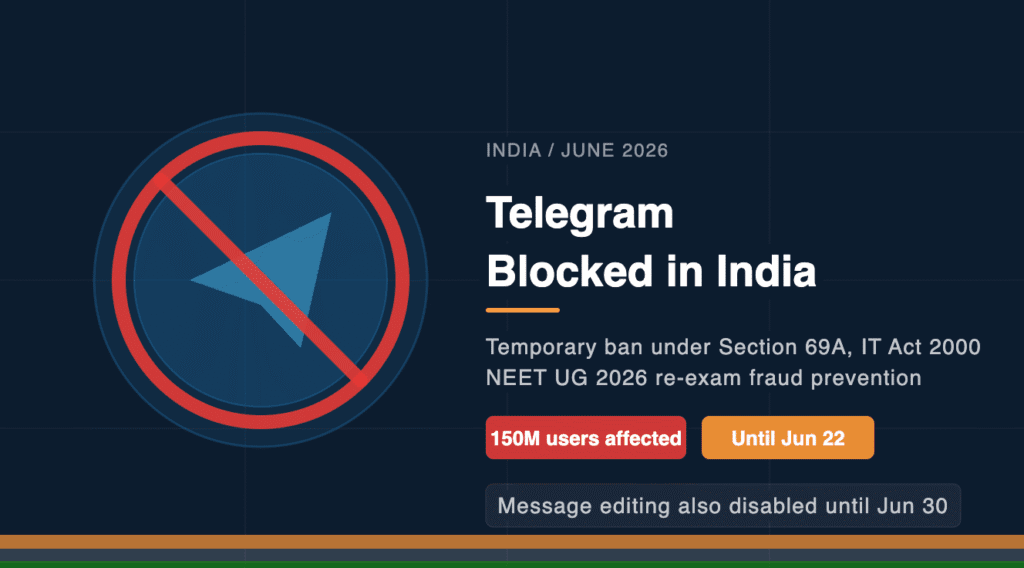
The Ministry of Electronics and Information Technology (MeitY) invoked Section 69A of the Information Technology Act, 2000, to implement the restriction. MeitY was acting on formal recommendations from the National Testing Agency (NTA).
Two separate orders were issued. The NTA imposed a temporary restriction on access to Telegram in India until June 22, 2026, ahead of the NEET (UG) 2026 re-examination scheduled for June 21. In addition to restricting access to Telegram, MeitY has directed the platform to disable its message-editing feature in India for already-posted messages until June 30, 2026.
So there are two distinct actions here: one blocks the app entirely for a week, the other forces Telegram to surgically remove a specific feature for Indian users until the end of the month. That second order, in particular, has raised some serious legal eyebrows.
The Technical Trick Scammers Were Using
This part is genuinely clever, in a deeply cynical way. Telegram channel administrators can edit any previously posted message at any time, including replacing attached PDF files, without a time limit. When a post is edited, the original timestamp remains visible to subscribers.
Think about what that means. Channel administrators posted placeholder messages before the exam window, then edited them afterward to insert exam-related content while keeping the original timestamp visible, making the posts appear to be pre-exam leaks.
So the scam was not actually leaking real exam papers. The NTA confirmed that no genuine NEET 2026 re-exam paper was in circulation, and every channel claiming to offer one was running a scam. These channels were charging desperate students anywhere from a few thousand to several lakhs of rupees for access to papers that did not exist, fabricating timestamps to make the fraud look credible.
That is the specific technical vulnerability the government is trying to close.
Why Telegram Specifically?
Fair question. WhatsApp exists. Signal exists. Why does Telegram keep coming up in Indian exam fraud cases?
A host of features make Telegram the go-to app for sharing files that would be difficult on other platforms. Telegram’s lack of a physical presence in India, it has no India office, makes it uniquely difficult to hold accountable or regulate.
That last point matters more than people realize. Platforms with no registered Indian entity are structurally harder to serve legal notices to, harder to compel compliance from, and harder to coordinate with during a fast-moving crisis. When you add large broadcast channels, anonymous admin accounts, and the ability to share large PDF files freely, you get a platform that scammers genuinely prefer over alternatives.
Before imposing the platform-wide restriction, authorities attempted to tackle the issue through channel-by-channel takedowns coordinated by the Indian Cyber Crime Coordination Centre (I4C) under the Ministry of Home Affairs. Those targeted removals failed to produce adequate compliance at the platform level. Only then did the NTA call for the full app block.
Is This Legal?
Depends who you ask.
The government says yes. Section 69A permits MeitY to block access to specific “information” on a computer resource.
The Internet Freedom Foundation says the order overreaches. The IFF argues that Section 69A and the Blocking Rules of 2009 permit the government to block access to specific information hosted on a platform, but not an entire intermediary service. They do not extend to switching off an entire intermediary, still less to ordering a company to redesign its product by removing a feature for a whole country.
The IFF specifically flagged that the message-editing direction identifies no legal source of power at all. The IFF called the move a band-aid solution and a disproportionate response to exam fraud, adding that a determined exam leak racket moves to a VPN or a mirror within minutes while ordinary users lose the service for a week.
That criticism is pointed and worth taking seriously.
What Telegram’s CEO Said
Pavel Durov did not stay quiet. Telegram founder Pavel Durov called the ban a rash decision, stating that India punished 150 million ordinary Telegram users, not the insiders who leaked the exam materials. He added that the ban failed to stop leaks, which merely shifted to other messaging apps like WhatsApp.
He has a point, at least partially. Blocking an app does not make fraudsters disappear. They adapt within hours. The question is whether the optics of appearing to act, combined with the short-term disruption to fraud channels, is worth the collateral damage to 150 million legitimate users.
Reasonable people disagree on that.
Is the Ban Actually Working?
Not fully, no. Hours after the government invoked emergency IT law powers to block the app, multiple users across India reported that the ban had not been enforced yet. Enforcement varies across ISPs. Users on different networks, including Jio, Airtel, BSNL, and Vi, may experience different outcomes depending on whether their provider has acted on the order yet.
This is a known weakness of India’s blocking infrastructure. Section 69A orders in India direct ISPs and telecom operators to block access to a platform or URL. However, enforcement is notoriously uneven and depends on individual ISPs implementing the block at their end. VPNs also render such blocks trivial to bypass.
So you may or may not be able to access Telegram right now, depending entirely on your carrier and whether they have pushed the block yet.
When Will Telegram Come Back?
According to the official MeitY directive, the full access restriction is slated to be reviewed and lifted on June 22, 2026. The message-editing feature will remain restricted until June 30, 2026.
The government has not indicated any intention to extend the block beyond this date, and there is no legislation pending that would make a Telegram ban permanent in India. This distinguishes the India block sharply from the situation in countries like Iran and China, where Telegram faces indefinite government-imposed restrictions.
So June 22 is the date to watch for full app restoration. The message-editing restriction runs another week beyond that.
The Bigger Picture
| Detail | Information |
|---|---|
| Law Used | Section 69A, IT Act 2000 |
| Ordered By | MeitY, on NTA’s recommendation |
| App Block Until | June 22, 2026 |
| Message Editing Blocked Until | June 30, 2026 |
| Users Affected | 150 million in India |
| Reason | NEET UG 2026 re-exam fraud prevention |
| Is It Permanent? | No |
| Legal Challenge Filed? | None as of June 16, 2026 |
Should You Use a VPN?
While some users attempt to access blocked apps through VPNs, circumventing a Section 69A government order may carry legal risk under Indian law. This article does not recommend doing so. The ban lifts June 22. Waiting a few days is the safer call.
What This Tells Us About App Regulation in India
The Telegram ban exposes a real structural gap. India has over 150 million Telegram users, making it the largest market globally by downloads in 2024. Yet the platform operates without a physical office in the country, making rapid enforcement nearly impossible in real time.
The NTA’s frustration is understandable. Fraudsters were using a specific technical loophole to run a large-scale extortion operation targeting students preparing for one of the most high-stakes medical entrance exams in the world. The channel-level takedown approach failed. Something had to give.
Whether a platform-wide block was the right answer is a separate debate. The IFF’s argument, that you are punishing 150 million people to inconvenience a handful of bad actors who immediately moved to WhatsApp, has real weight. So does the government’s position that they had exhausted more targeted options.
What is clear is that India’s current legal framework, specifically Section 69A, was written for a different era of the internet. Ordering a company to disable a feature for an entire country is genuinely new territory, and nobody has tested that authority in court yet.
Watch this space.
This article covers a developing situation as of June 17, 2026. Telegram’s access status may change as ISPs implement or roll back enforcement. Check your carrier’s network for current availability.