
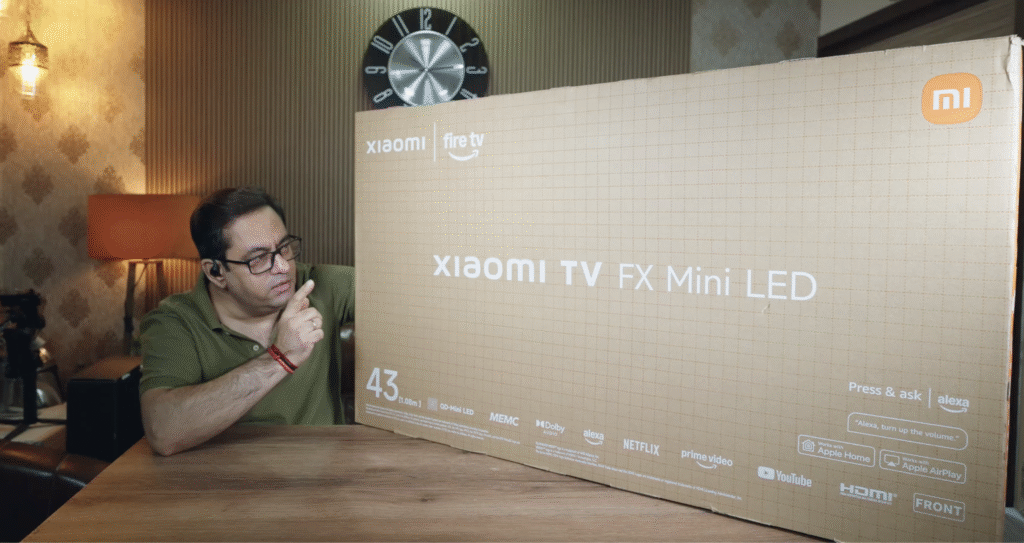
The Xiaomi TV FX Mini LED Series went on sale in India on June 11, 2026, in 43-inch, 55-inch, 65-inch, and 75-inch sizes. It runs Fire TV instead of Google TV, packs Full-Array Mini LED backlighting with local dimming, and starts at an introductory price of Rs 29,999 for the 43-inch. That’s the headline. Now let’s dig into whether the specs actually hold up.
Buy the Xiaomi TV FX Mini LED Series:
- 43-inch – Rs 32,999 (Introductory: Rs 29,999)
- 55-inch – Rs 44,999 (Introductory: Rs 39,999)
- 65-inch – Rs 64,999 (Introductory: Rs 59,999)
- 75-inch – Rs 84,999 (Introductory: Rs 79,999)
Note: The price may have changed, offers were for limited period
Table of contents
- Specifications at a Glance
- The Mini LED Difference, Explained Simply
- Fire TV Built-In: Not a Compromise, Actually
- Gaming and Sports: Where Size Actually Matters
- Sound: Quad Speakers Do Carry the Room
- Design and Build
- Connectivity
- Pricing vs the Competition
- What the 43-Inch Misses vs the Larger Sizes
- Who Should Buy This
- Bank Offers and Launch Discounts
- Final Word
Specifications at a Glance
| Feature | 43-inch | 55-inch | 65-inch | 75-inch |
|---|---|---|---|---|
| Display Technology | QD Mini LED, 4K UHD | QD Mini LED, 4K UHD | QD Mini LED, 4K UHD | QD Mini LED, 4K UHD |
| Resolution | 3840 x 2160 | 3840 x 2160 | 3840 x 2160 | 3840 x 2160 |
| Refresh Rate | 60Hz | 60Hz + DLG 120Hz | 60Hz + DLG 120Hz | 60Hz + DLG 120Hz |
| Local Dimming Zones | 36 | 54 | 76 | 104 |
| Contrast Ratio | 5000:1 | 5500:1 | 6000:1 | 6000:1 |
| HDR Support | HDR10, HDR10+ | HDR10, HDR10+ | HDR10, HDR10+ | HDR10, HDR10+ |
| Colour Gamut | 93% DCI-P3 | 93% DCI-P3 | 93% DCI-P3 | 93% DCI-P3 |
| Speakers | 20W, 2 drivers | 20W, 4 drivers | 20W, 4 drivers | 20W, 4 drivers |
| Screen-to-Body Ratio | 97% | 97% | 98% | 98% |
| RAM / Storage | 2GB / 32GB | 2GB / 32GB | 2GB / 32GB | 2GB / 32GB |
| OS | Fire TV | Fire TV | Fire TV | Fire TV |
| Processor | Quad-core Cortex-A55 | Quad-core Cortex-A55 | Quad-core Cortex-A55 | Quad-core Cortex-A55 |
| ALLM / MEMC | Yes | Yes | Yes | Yes |
| Regular Price | Rs 32,999 | Rs 44,999 | Rs 64,999 | Rs 84,999 |
| Introductory Price | Rs 29,999 | Rs 39,999 | Rs 59,999 | Rs 79,999 |
The Mini LED Difference, Explained Simply
Mini LED is not just a marketing term here. Traditional LED TVs push light from the edges or use a sparse grid behind the panel. The FX Mini LED uses Full-Array Mini LED backlighting, meaning thousands of tiny LEDs cover the entire back panel. Pair that with local dimming zones (36 on the 43-inch, up to 104 on the 75-inch) and what you get is much finer control over which parts of the screen are bright and which go dark.
The result: deeper blacks, brighter highlights, and noticeably better HDR10+ performance compared to a standard QLED or plain LED TV in this price range.
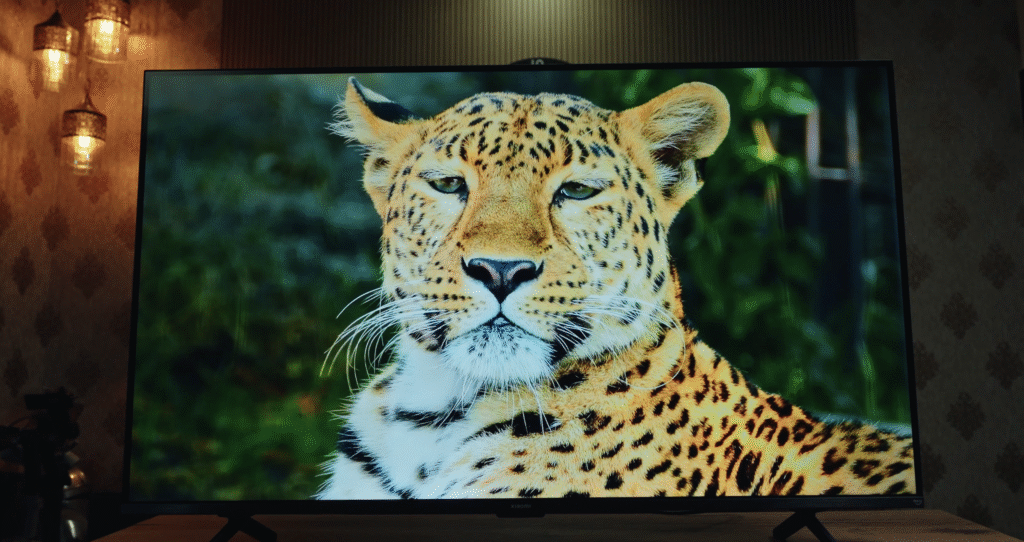
On top of that sits Quantum MagiQ technology (Xiaomi’s term for the quantum dot layer), which pushes the colour gamut to 93% of DCI-P3. That means more vivid reds, greens, and blues compared to what standard LED panels manage. The TV is also capable of rendering up to 1.07 billion colours, which sounds like a spec sheet boast but does translate to smoother gradients in real content.
Filmmaker Mode is included too. Watch a movie in that mode and the TV turns off all post-processing, showing content exactly as the director graded it.
Fire TV Built-In: Not a Compromise, Actually
Xiaomi chose Fire TV here instead of Google TV, which some buyers will prefer and others will not. Fire TV gives you access to over 12,000 apps, including Prime Video, Netflix, YouTube, Jio Hotstar, Airtel Xstream Play, Apple TV, and most streaming platforms Indians actually use. The installation process links to your Amazon account, and from there it feels familiar if you’ve ever used a Fire TV Stick.
Alexa is built in, which means voice control is not a gimmick bolted on as an afterthought. You can ask Alexa to play content, switch inputs, check cricket scores, control smart home devices, or adjust the volume. The remote includes a dedicated Alexa button alongside shortcut keys for Prime Video, Netflix, live TV, apps, and the internet.
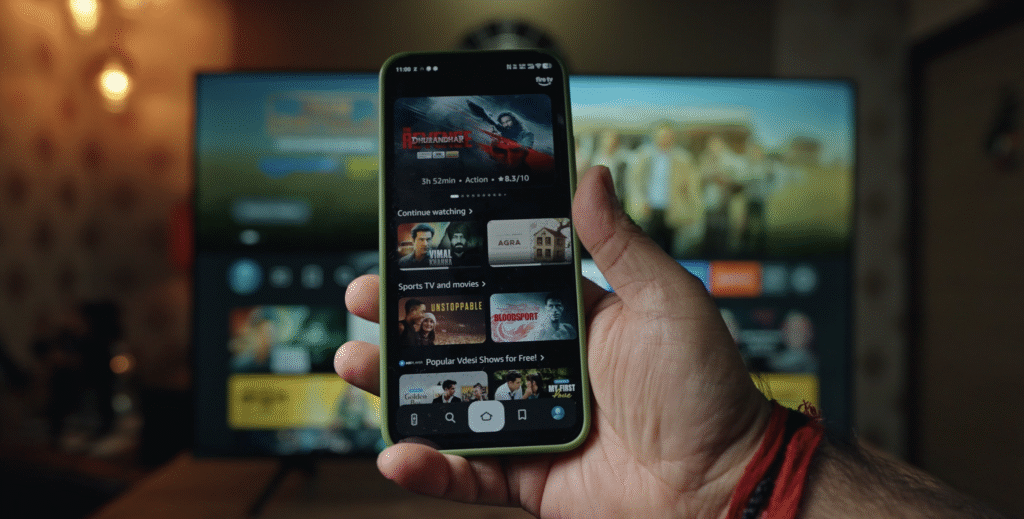
A couple of things that make the Fire TV experience genuinely useful:
The Fire TV mobile app connects to the TV over Bluetooth, turning your phone into a remote. Better yet, you can browse content on your phone and push it to the TV with a tap. If you were watching something on Prime Video on your phone and want to continue on the big screen, it transfers seamlessly.
Personalised profiles let each family member have their own watchlist, recommendations, and home screen. Parental controls come with PIN protection and content filters.
For Apple users: AirPlay 2 is supported, so you can mirror your iPhone, iPad, or Mac to the screen without any cables or dongles. Android users get Miracast for the same purpose. Bluetooth audio output lets you pair wireless headphones or a soundbar. HDMI CEC means your existing remote can control the TV and connected devices together.
Gaming and Sports: Where Size Actually Matters
The 43-inch is a solid TV. But if gaming or sports is the main reason you’re buying, the 55-inch and above variants offer something the 43-inch does not: DLG 120Hz Game Mode.
DLG 120Hz is software-driven, not a native 120Hz panel. Xiaomi claims typical response times of around 6.5ms in this mode. That is not going to satisfy someone coming from a gaming monitor, but for TV gaming it is a genuine improvement over 60Hz especially in fast-paced titles. ALLM (Auto Low Latency Mode) kicks in automatically when a game console is detected, switching the TV to its lowest-latency picture profile without you having to dig through menus.
MEMC (Motion Estimation and Motion Compensation) handles motion smoothing for sports and action content. One HDMI port supports HDMI 2.1, and you also get eARC on that port for lossless audio passthrough to a compatible soundbar.
The 43-inch sticks to 60Hz and has 36 local dimming zones. Decent for casual gaming and streaming, but not the one to pick if competitive gaming is the priority.
Sound: Quad Speakers Do Carry the Room
The 55-inch, 65-inch, and 75-inch models use a four-driver speaker setup with two full-range drivers and two high-frequency tweeters pushing 20W total. The 43-inch gets a simpler dual full-range driver configuration at the same 20W output.
Dolby Audio, DTS:X, and DTS Virtual:X are all supported. DTS Virtual:X does attempt to simulate height and surround channels through the built-in speakers, which won’t match a real soundbar setup but does give movies and live events more dimensionality than flat stereo. Dialogue clarity and music reproduction on the quad-driver variants are genuinely respectable for a TV in this price range.
If you want a soundbar, the optical output and eARC HDMI port give you clean options for connection.
Design and Build
The bezel situation is good. 97% screen-to-body ratio on the 43-inch and 55-inch, 98% on the 65-inch and 75-inch. In practical terms, the bezels are thin enough to stop being something you notice after the first hour of use. The metallic frame is premium-looking in person and holds up better than the plastic builds seen on TVs at similar or even higher prices a few years back.
The 360-degree Bluetooth remote is worth mentioning because it works even when not pointed directly at the TV, which is more convenient than it sounds.
Box contents include the TV, stand (plastic, sturdy), power cord, stand screws, remote with batteries, and an installation guide. Free installation is included.
Connectivity
| Port / Feature | Details |
|---|---|
| HDMI | 3 ports (HDMI 2.0 + HDMI 2.1 with eARC) |
| USB | 2 x USB 2.0 |
| Audio Out | 3.5mm jack + Optical |
| AV Input | Yes |
| Ethernet | Yes (RJ45) |
| Wi-Fi | Dual-band 802.11ac (2.4GHz + 5GHz) |
| Bluetooth | 5.0 |
| AirPlay | AirPlay 2 |
| Screen Mirror | Miracast |
Pricing vs the Competition
| TV | Technology | OS | Price (43-inch equiv.) |
|---|---|---|---|
| Xiaomi FX Mini LED | QD Mini LED | Fire TV | Rs 29,999 |
| Xiaomi FX Pro | QLED | Fire TV | Rs 26,999 |
| Hisense U7N | Mini LED | Google TV | Rs ~35,000 |
| TCL C655 | Mini LED | Google TV | Rs ~38,000 |
| Samsung QN85B | Neo QLED | Tizen | Rs 65,000+ |
At Rs 29,999 introductory, the FX Mini LED is probably the most affordable Mini LED TV in India right now in the 43-inch segment. Hisense and TCL charge more for their Mini LED options, and Samsung’s Neo QLED (their Mini LED equivalent) starts much higher.
What the 43-Inch Misses vs the Larger Sizes
Worth knowing before you buy:
- No DLG 120Hz on the 43-inch. You get 60Hz only.
- Fewer local dimming zones: 36 vs 54 (55-inch), 76 (65-inch), 104 (75-inch).
- Lower contrast ratio: 5000:1 vs 5500:1 and 6000:1 on the bigger models.
- Two speakers instead of four.
If you’re buying for a bedroom or a smaller living room and don’t game, the 43-inch is fine. For the main living room TV, the 55-inch at Rs 39,999 introductory is the better value.
Who Should Buy This
Buy the 43-inch if: You want Mini LED at the lowest possible price, use the TV primarily for streaming, and are placing it in a bedroom or a smaller room where 60Hz is not a limitation.
Buy the 55-inch if: You want the full experience including 120Hz gaming mode, quad speakers, and better contrast without spending more than Rs 40,000 during the introductory period. This is the sweet spot in the lineup.
Buy the 65-inch if: You have a proper living room setup and want the TV to carry the room. 76 local dimming zones and 6000:1 contrast make a visible difference on a panel this size.
Consider the 75-inch if: You want near-projector-level screen real estate and have the wall space for it. The 75-inch ships at a later date; confirm availability before ordering.
Skip this if: You are firmly in the Google TV camp and don’t want to learn a different interface. Fire TV is not worse than Google TV, but it is different, and if your household is already deep into Chromecast or Google Assistant habits, that will take some adjustment.
Bank Offers and Launch Discounts
Xiaomi is running introductory bank offers at launch:
- 43-inch: Rs 2,000 off on HDFC Credit Card EMI + Rs 1,000 instant discount
- 55-inch, 65-inch, 75-inch: Rs 3,000 off on HDFC Credit Card EMI + Rs 2,000 instant discount
These are limited-period offers. Check the current offer status at checkout.
Final Word
Mini LED for under Rs 30,000 is a statement. The Xiaomi FX Mini LED Series does not pretend to be a flagship television, but it delivers technologies that were sitting in the Rs 60,000-plus bracket just two years ago. Full-Array Local Dimming, Quantum Dot colour, HDR10+, and Fire TV with Alexa in one box at Rs 29,999 is a hard argument to counter.
The 43-inch’s 60Hz limitation and lower zone count are real caveats for serious gamers. But for the vast majority of buyers watching cricket, films, and shows in a medium-sized room, it is more than capable.
The 55-inch at Rs 39,999 is the variant this lineup will likely be remembered for. That’s where the spec bump makes the price jump feel completely worth it.