
Around 2015, Indian smartphone brands controlled nearly half of the local market. By 2025, according to Nothing CEO Carl Pei, their combined share had dropped to less than 1%.
Now Pei wants CMF to take a different path.
In a letter titled “India Is Inevitable”, Pei explains why he believes India’s next big opportunity in consumer electronics is not just manufacturing, but research and development, or R&D.
The plan is to make CMF a standalone company headquartered in India, with majority Indian ownership, its own team and R&D operations in the country. Nothing will remain involved as a shareholder and partner.
Table of contents
- CMF India Private Limited: What Is Changing?
- Why Indian Smartphone Brands Lost Their Market Share
- What Does Real Smartphone R&D Actually Mean?
- Nothing’s India Plan: Manufacturing Was Only the Beginning
- Why Carl Pei Points to China as an Example
- India’s Smartphone Opportunity in Numbers
- What CMF Will Get From Nothing
- Carl Pei’s 100 Million Smartphone Target
- CMF Phones, Watches and Audio Products Available in India
- What Happens Next for CMF India?
CMF India Private Limited: What Is Changing?
Nothing first announced plans in September 2025 to separate CMF and turn it into an India-based business.
TechCrunch reported that the move also involved a manufacturing joint venture with Indian electronics company Optiemus.
The partnership was linked to an investment of more than $100 million and the creation of over 1,800 jobs across three years.
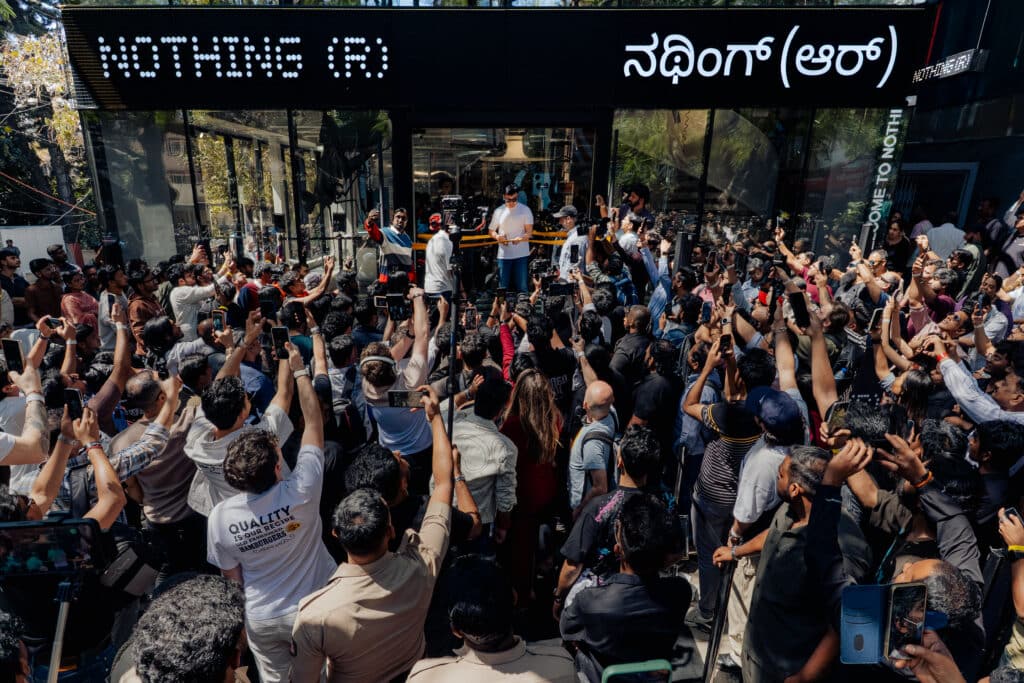
CMF has since reportedly been registered as CMF India Private Limited.
Pei’s latest letter gives more clarity about the ownership structure. CMF will be incorporated in India, operated from India and mostly owned by Indian shareholders.
Nothing will bring its existing technology, software knowledge, supplier relationships and global branding experience to CMF.
The idea is simple: Nothing provides the foundation it has already built, while CMF grows as an Indian company using local talent, engineering and market experience.
Why Indian Smartphone Brands Lost Their Market Share
Pei looks back at the Indian smartphone market of 2015, when local brands held close to half the market.
One Indian brand even managed to briefly move ahead of Samsung in smartphone sales.
But the situation changed quickly.
According to Pei, foreign smartphone companies entered India with much stronger engineering capabilities. They were launching better phones every year with improved cameras, stronger software integration and better designs.
Many Indian companies, meanwhile, depended heavily on white-label products.
A white-label smartphone is basically a ready-made phone designed by another manufacturer. A brand may change the logo, colours or back panel, but most of the engineering work has already been done elsewhere.
Pei believes this approach made it difficult for Indian companies to keep improving their products.
By 2025, Indian brands reportedly held less than 1% of the smartphone market they once dominated.
His argument is that once pricing offers and marketing excitement disappear, the quality of the actual product becomes the biggest differentiator.
What Does Real Smartphone R&D Actually Mean?
Almost every technology company talks about R&D, but Pei says there are some simple ways to find out how much engineering a brand actually does.
| Area | What It Means |
|---|---|
| Phone structure | Who designs the materials, cooling system, durability and internal construction? |
| Camera system | Who selects the camera sensors and develops the image-processing pipeline? |
| Operating system | Who develops and maintains the software and provides long-term updates? |
| Antennas | Who tunes and certifies the antennas whenever the phone design changes? |
| Suppliers | Does the company directly work with display, chipset and camera suppliers? |
If most of these jobs are handled by a manufacturing partner, Pei argues that the company is mostly selecting an existing phone rather than creating one.
That model can work, but it often leads to heavy competition on price.
A company with its own engineering team can make more meaningful changes, reduce unnecessary supplier markups and improve its products generation after generation.
Nothing’s India Plan: Manufacturing Was Only the Beginning
Pei also credits India’s long-term push towards local smartphone manufacturing.
According to the letter, around 99% of smartphones sold in India are now manufactured in the country, compared to almost none about a decade ago.
Pei believes the next step should be R&D and product engineering.
Manufacturing brings factories and jobs. Engineering can go further by encouraging component suppliers to develop technology locally as well.
Pei says much of the important intellectual property, or IP, behind smartphones still sits outside India.
IP includes the designs, engineering knowledge, software and technologies used to create the final product.
His view is that suppliers will only develop more advanced technology locally when smartphone companies start asking them to create something new instead of simply buying parts that already exist.
Why Carl Pei Points to China as an Example
Pei moved from Stockholm to Shenzhen in 2012 and remained there until 2020.
During that period, he says he saw a major change in the smartphone supply chain.
Companies from Korea and Japan were once considered leaders in components such as displays and camera modules, while many Chinese suppliers focused mainly on lower-cost parts.
That changed as Chinese smartphone makers started demanding better components.
They wanted thinner modules, brighter screens, stronger hinges and other improvements.
Every new demand forced suppliers to improve their engineering capabilities.
Over time, many suppliers became technology partners instead of companies simply selling standard components.
Pei believes India could follow a similar path if smartphone brands start building serious engineering teams locally.
India’s Smartphone Opportunity in Numbers
The letter highlights several numbers to explain why Pei sees India as a major opportunity.
| Figure | What It Represents |
|---|---|
| 99% | Smartphones sold in India that are now made in India |
| 150 million+ | Approximate smartphones bought in India every year |
| Under 1% | Indian smartphone brands’ market share in 2025, according to Pei |
| 100 million | Annual volume Pei sees as the point where a phone brand becomes a platform |
| No. 2 | India’s position among the world’s largest smartphone manufacturing countries |
India is already a huge smartphone market. Pei’s argument is that the next challenge is to create companies that control more of the technology behind those devices.
What CMF Will Get From Nothing
Nothing says CMF will not be starting from zero.
Several technologies and capabilities already developed by Nothing will support the new company.
Nothing OS
Nothing has developed its own Android-based software experience, including camera processing and device-specific software features.
The company says it has also provided regular software updates across its devices since 2021.
Industrial Design
Nothing and CMF products are known for having a distinct design language.
The company has also received Red Dot and iF design awards for some of its products.
Direct Supplier Relationships
Nothing says it already works directly with suppliers for important components such as displays, chipsets and camera modules.
Global Market Presence
Nothing products are already available in several countries, including India.
CMF could use this distribution and brand experience while operating as an India-based company.
Strong Growth in India
CMF was also described as India’s fastest-growing smartphone sub-brand in 2025.
IDC data reported by TechCrunch showed Nothing, including CMF devices, increasing its India smartphone shipments by around 85% year-on-year during Q2 2025, with market share crossing 2%.
Carl Pei’s 100 Million Smartphone Target
One of the most interesting parts of Pei’s letter is his focus on 100 million smartphones per year.
He believes this is the level at which a smartphone company stops being just another customer of component suppliers and starts influencing what those suppliers actually build.
At smaller volumes, brands usually select from technologies already available in the market.
At much larger volumes, suppliers may be willing to create components specifically for one company.
That could include custom displays, camera hardware, software technologies and even AI features.
Pei also argues that big investments in software, camera engineering and AI become easier to justify when those costs can be spread across tens of millions of devices.
Only a small number of smartphone companies have reached that kind of scale.
Pei believes India could become the base for the next company that does.
CMF Phones, Watches and Audio Products Available in India
The larger R&D plan may take years to develop, but CMF already sells several products in India.
CMF Phone 2 Pro
The CMF Phone 2 Pro comes with a 6.77-inch AMOLED display, MediaTek Dimensity 7300 Pro processor, 5,000mAh battery and 33W charging.
CMF Watch 3 Pro
The CMF Watch 3 Pro features a 1.43-inch AMOLED screen, dual-band GPS and support for more than 130 sports modes.
CMF Headphone Pro
The CMF Headphone Pro comes with 40mm drivers, LDAC high-resolution audio support and up to 40dB noise cancellation.
CMF Buds 2 Plus
The CMF Buds 2 Plus offer adaptive noise cancellation, 12mm drivers and an IP55 rating for the earbuds.
You can also browse current Nothing phones or check the Nothing collection for more products.
What Happens Next for CMF India?
Carl Pei’s letter gives CMF a clear direction, but there is still no detailed timeline explaining how quickly the company will build its Indian R&D operations.
The biggest things to watch will be the size of the CMF India engineering team, where its R&D centres are located, how Nothing OS updates are handled and which component suppliers start working directly with the new company.
The bigger goal goes beyond simply assembling smartphones in India.
Pei wants CMF to become a company that designs, engineers and develops technology from India for the global market.
India has already proved that smartphones can be manufactured here at massive scale.
CMF now wants to find out whether the next major global smartphone brand can be engineered here too.