
A NAS system can stay powered on day and night, constantly reading and writing files. That kind of workload can be demanding on regular storage drives. Sandisk has now introduced two SSDs made specifically for this purpose: the Sandisk NAS 600 SATA SSD and Sandisk NAS 800 NVMe SSD.
Both are designed for home users, content creators, professionals and small businesses that need reliable storage for systems running 24/7.
Table of contents
Why Use an SSD in a NAS?
A NAS, or Network Attached Storage system, is basically a small storage server connected to your home or office network. Multiple devices and users can access files stored on it at the same time.
Unlike a normal laptop or desktop drive, storage inside a NAS may stay active for long periods.
This is why endurance matters.
SSD endurance is commonly measured in TBW, or terabytes written. A higher number means the SSD is designed to handle more data being written over its lifetime.
Another specification is MTTF, or Mean Time To Failure. This gives an estimated reliability figure based on testing. It does not mean every drive will actually run for that exact number of hours.
Sandisk NAS 600 SATA SSD Specifications
The Sandisk NAS 600 is the more straightforward option for people using traditional SATA-based NAS systems.
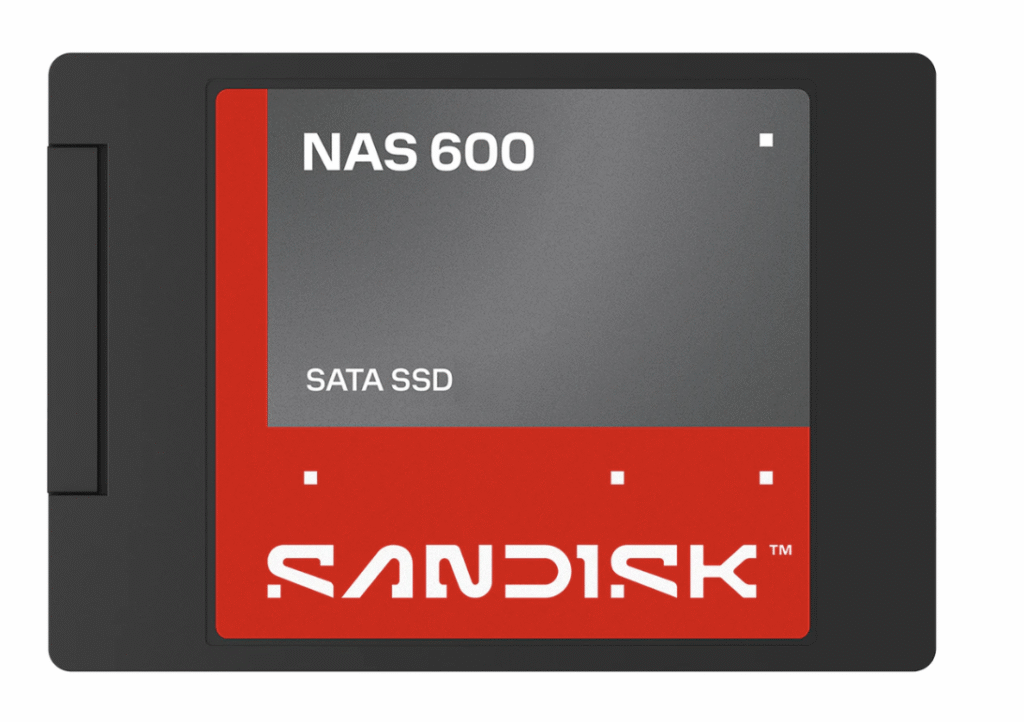
It can be useful as a replacement for older hard drives or as SSD storage in compatible NAS enclosures.
| Specification | Details |
|---|---|
| Interface | SATA III 6Gb/s |
| Form factor | 2.5-inch, 7mm |
| Capacities | 500GB, 1TB, 2TB, 4TB |
| Endurance | Up to 2,500 TBW on 4TB model |
| MTTF | Up to 2.25 million hours |
| Sequential read speed | Up to 560MB/s |
| Warranty | 5-year limited warranty |
The 2.5-inch SATA design should also make it easier to use with many existing NAS systems that support 2.5-inch drives.
For users moving from mechanical hard drives, the biggest improvements should be faster response times, silent operation and no vibration.
Sandisk NAS 800 NVMe SSD Specifications
The Sandisk NAS 800 is aimed at much faster and more demanding NAS setups.
It uses a PCIe 5.0 NVMe interface and comes in the M.2 2280 form factor.
| Specification | Details |
|---|---|
| Interface | PCIe 5.0 NVMe |
| Form factor | M.2 2280 |
| Capacities | 960GB, 1.92TB, 3.84TB, 7.68TB |
| Endurance | Up to 14 PBW on 7.68TB model |
| Sequential read/write | Up to 14,900MB/s / 13,200MB/s |
| Random read/write | Up to 2.3M / 2M IOPS |
| Warranty | 5-year limited warranty |
The performance numbers are far higher than what a SATA SSD can offer.
This makes the NAS 800 better suited for workloads such as video editing, multi-user file access, virtualization, databases and local AI storage.
Of course, your NAS hardware must support M.2 PCIe 5.0 storage to take advantage of these speeds.
Sandisk NAS 600 vs NAS 800
The two SSDs are meant for very different types of NAS systems.
| Feature | Sandisk NAS 600 | Sandisk NAS 800 |
|---|---|---|
| Best for | Home NAS, HDD replacement, SATA systems | High-performance NAS and servers |
| Connection | SATA III | PCIe 5.0 NVMe |
| Form factor | 2.5-inch | M.2 2280 |
| Typical workload | File storage, backups, basic sharing | Editing, virtualization, databases, AI workloads |
| Noise | Silent | Silent |
For a normal home NAS or small office file server, the NAS 600 should make more sense.
The NAS 800 is aimed at users who need much higher performance and already have compatible hardware.
Sandisk NAS 600 and NAS 800 Price
The Sandisk NAS 600 SATA SSD starts at $179.99 for the 500GB model.
The faster Sandisk NAS 800 NVMe SSD starts at $309.99 for the 960GB version.
Both drives are expected to roll out through Sandisk.com and selected retailers starting in September 2026.
Indian pricing has not been announced yet.
Where to Check Sandisk NAS SSDs Online
You can keep an eye on Indian availability using the links below.
Check Sandisk NAS 600 SATA SSD listings
Browse Sandisk NAS 800 NVMe SSD options
See other high endurance NAS drives
The new Sandisk NAS SSD range looks interesting for anyone who wants faster, quieter and more durable storage inside a NAS.
The NAS 600 should appeal more to regular home and small office users, while the NAS 800 is clearly designed for heavier workloads where speed and endurance matter much more.