
A regatta start sequence lasts exactly ten minutes, and getting it wrong by even a few seconds can cost a race. Rolex built an entire watch around solving that problem back in 2007, and now, marking 100 years of the Oyster case, the brand has rebuilt it from the ground up. The new Rolex Yacht-Master II keeps the countdown chronograph concept that made the original famous, but almost everything else, from the dial to the movement inside, has been reworked.
For a watch this technical, most of what makes it special is not obvious at a glance. Here is what actually changed, why it matters, and what it means for buyers in India.
Table of contents
A Dial Built Around One Very Specific Job
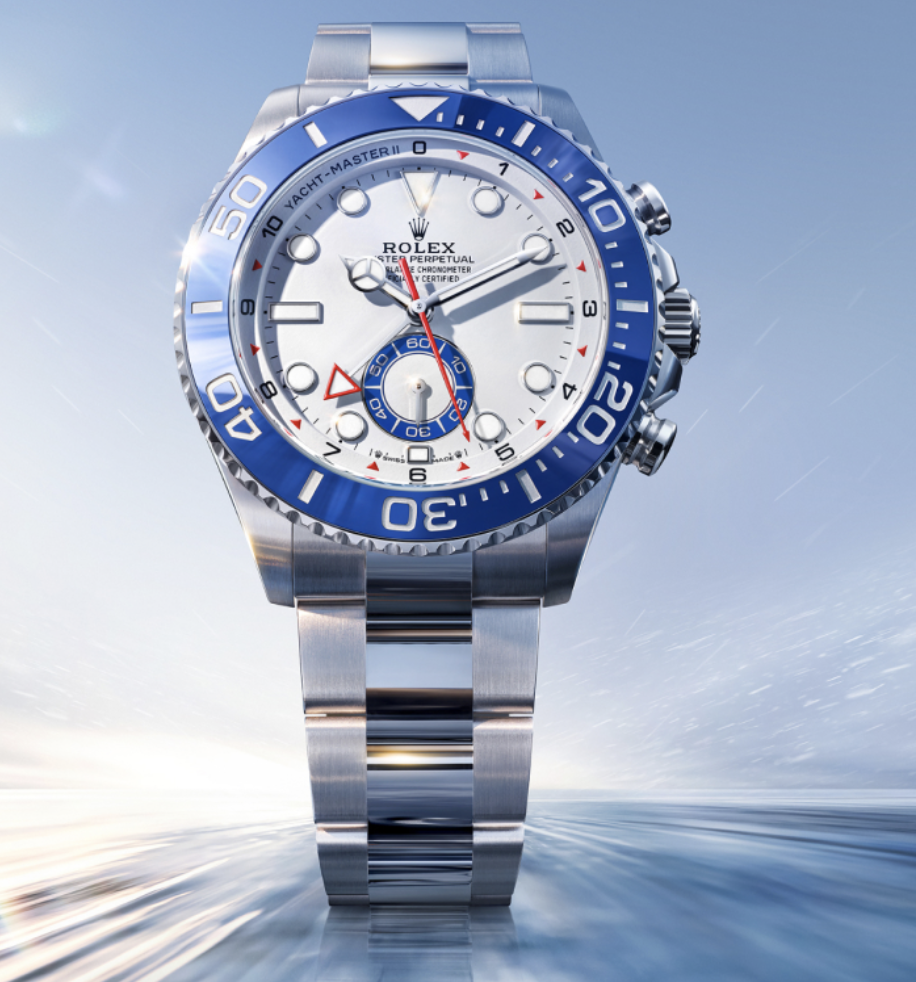
The Yacht-Master II exists to count down ten minutes with precision, and the new dial is designed entirely around making that countdown easy to read at a glance. Rolex has switched to a matt white lacquer dial finish that cuts down reflections, paired with applique index hour markers borrowed from the brand’s Professional watch line.
The bigger change sits at the edge of the dial. A flange, which is the sloped ring between the dial and the crystal, now carries the countdown scale itself. It is graduated from 10 down to 0 minutes, with half-minute marks shown as small triangles. Rolex says it filed a patent for how precisely this flange is positioned, which tells you how much engineering went into something that looks like a simple printed ring.
Cerachrom Bezel: What the Ceramic Actually Does
The bezel uses Rolex’s Cerachrom insert, a high-tech ceramic material the brand has been refining across its sports watch lineup for years. On the Yacht-Master II, it comes in blue with 60-minute graduations, and the numerals are coated in platinum or yellow gold using a vapour deposition process rather than printed on.
Ceramic sounds fragile, but it is the opposite here. Cerachrom is virtually scratchproof, will not fade under UV light, and does not corrode. The bezel is bidirectional and knurled for grip, so a sailor can use it to time intervals between buoys, not just the initial countdown.
The Bracelet Gets Smarter Adjustments
The watch sits on Rolex’s classic Oyster bracelet, a three-piece link design the brand has used since the late 1930s for its durability. What is new is the clasp mechanism. The Oysterlock safety clasp now includes an Easylink extension, a small folding link that lets the wearer add roughly 5mm of length on the fly, useful when a wrist swells slightly in heat or after exertion.
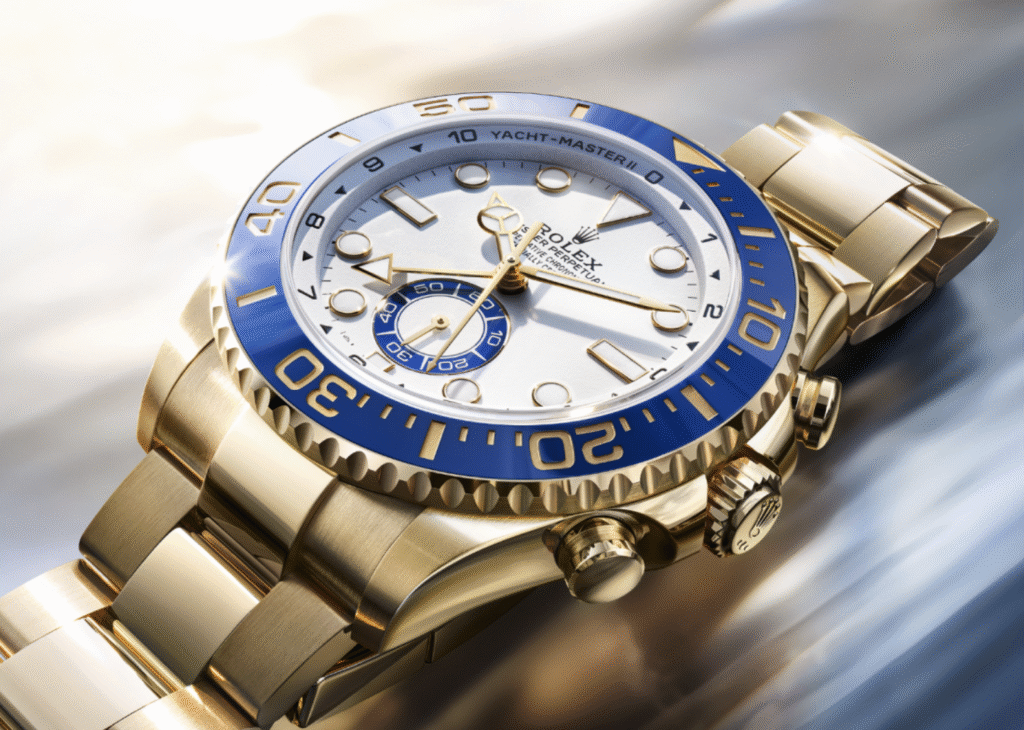
The 18 ct yellow gold version goes a step further, with ceramic inserts hidden inside the bracelet links themselves to resist wear over years of use.
Calibre 4162: The Movement Doing the Real Work
Inside is calibre 4162, a new self-winding chronograph movement built specifically for this watch, replacing the outgoing calibre 4161. The countdown function runs on a column wheel and vertical clutch system, mechanical parts that allow the chronograph to start and stop instantly without any lag, a detail that matters when a race sequence is measured in seconds.
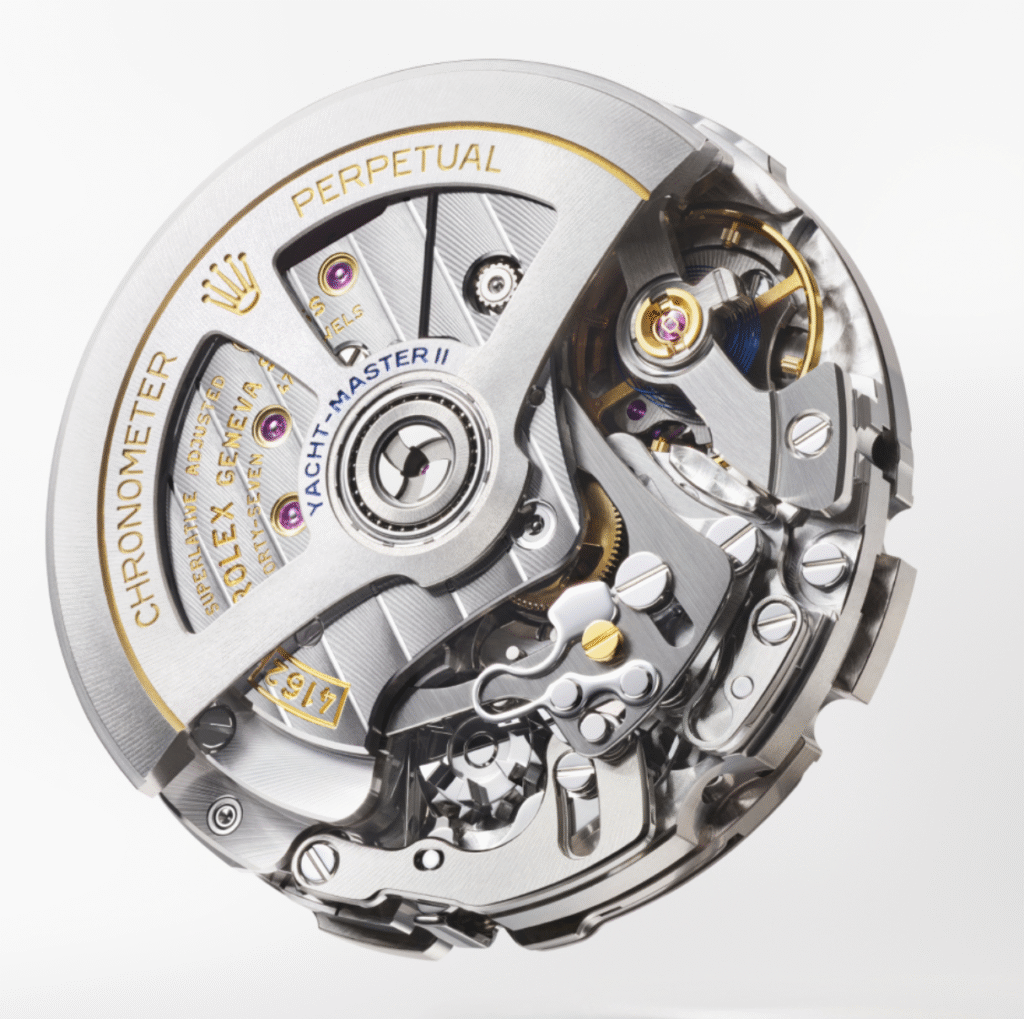
Rolex has also carried over its Chronergy escapement, a component that improves how efficiently the movement uses energy. The result is a power reserve of approximately 72 hours, meaning the watch can sit unworn over a weekend and still be running accurately on Monday. Even the finishing is deliberate, with Côtes de Genève striping on the bridges and a cut-out oscillating weight visible through the caseback on display models.
Superlative Chronometer Certification Just Got Stricter
Every Yacht-Master II carries Rolex’s Superlative Chronometer certification, an in-house standard that goes beyond the industry’s official chronometer testing. In 2026, Rolex added three new checks to this certification: resistance to magnetism, long-term reliability, and sustainability, on top of the existing precision, waterproofness, self-winding, and power reserve tests introduced in 2015.
The accuracy bar is tight. After the movement is cased, the finished watch must run between minus 2 and plus 2 seconds a day, a tighter window than what is required for basic chronometer certification of the movement alone. Every watch that passes gets the brand’s green seal and a five-year international guarantee.
Price and Availability in India
The new 44mm Yacht-Master II in Oystersteel is listed on Rolex’s official India site at approximately ₹18,77,500, with the 18 ct yellow gold version priced significantly higher. Rolex watches are sold in India exclusively through the brand’s own boutiques and a small number of authorised retailers such as Ethos and Kapoor Watch Co, so this is not a watch you will find listed for direct purchase on regular e-commerce marketplaces.
That said, owning a mechanical chronograph like this usually comes with a shopping list of its own. A few accessories are genuinely useful for anyone stepping into this category:
| Accessory | What It Is For |
|---|---|
| Watch winder | Keeps an automatic movement wound and running when the watch is not being worn |
| Watch cleaning kit | Microfiber cloths and brushes for cleaning the bracelet and case without scratching it |
| Watch case or box | Padded storage that protects the bracelet and crystal when travelling |
| Loupe or jeweller’s magnifier | Useful for inspecting bezel engravings, hallmarks, and movement finishing |
The Bigger Picture
What stands out about this update is how much of it is invisible in photos. The flange, the escapement, the clasp extension, none of it changes how the watch looks from across a room, but all of it changes how the watch performs when it is actually being used for its intended job. That is a fairly Rolex way of approaching a redesign: keep the silhouette recognisable, rebuild the parts that do the work.
For India, the bigger story might simply be availability through official boutique channels alongside the rest of the 2026 collection, giving buyers here the same access to the update as markets abroad.
Source : Ethos Watches